
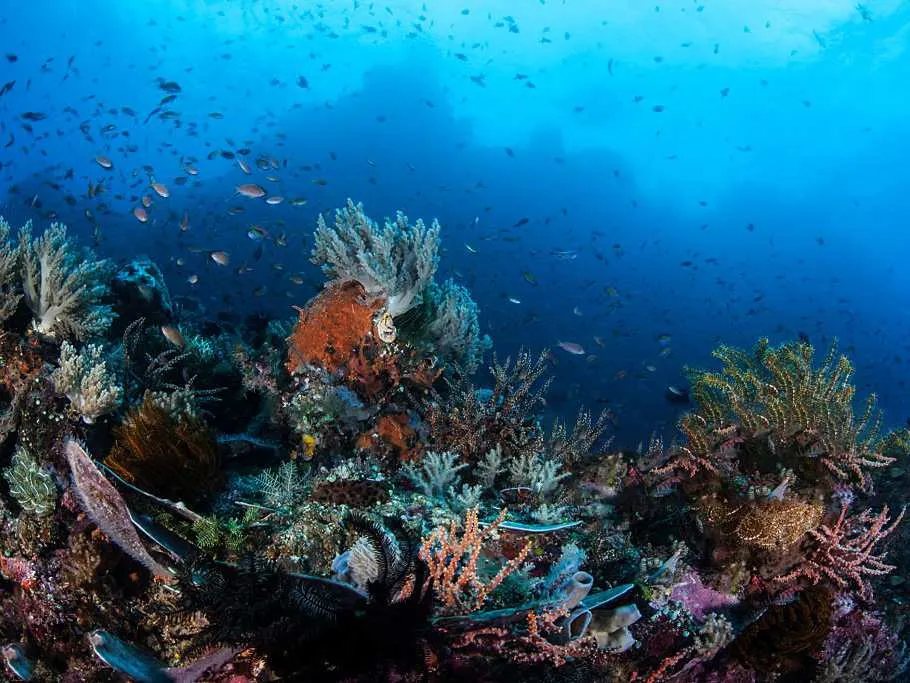
Quick Answer: Beneath Raja Ampat's pristine waters lie remnants of the Pacific War — including a P47 Thunderbolt fighter now transformed into a living reef. Our luxury charters combine wreck diving with world-class coral reef exploration, complete with historical briefings that bring context to what you see underwater. The intersection of history and marine biology, accessible only by private vessel.
Beneath the same surface where manta rays glide and coral gardens bloom in the world's most biodiverse waters, the remnants of the Pacific War lie in silent testimony. American fighter planes, Japanese supply vessels, and the scattered debris of aerial combat have rested on Raja Ampat's seafloor for over eighty years — and in that time, the ocean has done something remarkable. It has transformed instruments of war into gardens of life.
The most famous of these wrecks is a P47 Thunderbolt — a single-seat American fighter that went down in Raja Ampat's waters during the Pacific campaign. Today, its fuselage is encrusted with hard and soft corals that have colonized every surface. Octopuses nest in the cockpit. Lionfish hover around the wing edges. Schools of fusiliers swirl above the tail section. The propeller, still recognizable, is draped in sea fans that sway in the gentle current. It is simultaneously a war grave, an artificial reef, and one of the most hauntingly beautiful dive sites in the Indo-Pacific.
Pacific War
The History
Raja Ampat's strategic position — sitting astride shipping lanes that connected Japanese-held territories across Southeast Asia and the Pacific — made it a contested theater during World War II. American forces conducted bombing runs against Japanese supply lines, and Japanese anti-aircraft positions defended key passages. Aircraft from both sides went down in these waters, some in combat, others from mechanical failure over the vast distances of the Pacific.
The connection between WWII history and Raja Ampat's modern identity as a diving destination is direct and personal. Max Ammer — widely credited as the pioneer of recreational diving in Raja Ampat — first came to the region after hearing stories of downed WWII aircraft from the island of Morotai. His initial mission was wreck exploration. What he found instead was the most extraordinary coral reef system on Earth, and his subsequent efforts to promote and protect Raja Ampat's reefs laid the foundation for the marine park and tourism ecosystem that exists today.
There is a poetic symmetry in this: a man came looking for the wreckage of war and discovered the world's greatest underwater paradise. The wrecks are still there, but they have been absorbed into the reef, becoming part of the living system rather than relics of destruction.
Underwater Journey
The Wreck Dive Experience
Our pre-dive briefing transforms a wreck dive from a simple underwater visit into a journey through history. In the salon, your dive master presents the specific aircraft or vessel you will be diving: its type, its mission, the circumstances of its loss (where known from historical records), and the marine life that has since colonized it. Understanding that the octopus living in the cockpit of a P47 Thunderbolt has made its home in a machine that was traveling at 400 mph when it went down adds a layer of meaning that pure reef diving cannot replicate.
The dives themselves combine historical exploration with the standard Raja Ampat marine life bonanza. Wreck sites typically feature denser marine life than surrounding reefs — the structure creates shelter, feeding opportunities, and current breaks that concentrate fish. The coral growth on metal surfaces is often more vivid than on natural reef substrate, as the mineral content of the dissolving metal enriches the surrounding water.
Insider Tip
The luxury charter advantage for wreck diving is time. Group liveaboards that include a wreck site in their itinerary typically allow one dive and move on. Our private charters can schedule multiple dives at the same wreck — a wide-angle exploration dive in the morning when light penetrates best, followed by a macro dive in the afternoon focusing on the critters that have colonized specific sections. For photographers, this dual-dive approach at a single wreck produces dramatically better images.
Integrated Itineraries
Combining History with Marine Paradise
WWII wreck dives integrate seamlessly into broader Raja Ampat itineraries. A typical day might begin with a dawn dive at a pristine coral reef, followed by a wreck dive mid-morning when light angles are optimal for underwater photography, and conclude with an afternoon snorkel or second reef dive. The contrast between the natural reef's organic forms and the wreck's geometric angles creates a compelling visual and emotional narrative across the day.
For history enthusiasts, we can design itineraries that connect multiple wreck sites across the archipelago, creating a WWII trail through Raja Ampat's waters that tells the broader story of the Pacific War's impact on this remote corner of Indonesia.
Practical Information
| Detail | Information |
|---|---|
| Certification required | Open Water minimum; Advanced recommended for deeper wrecks |
| Depths | 15-35m depending on wreck site |
| Visibility | 15-30m at wreck sites (varies with season) |
| Historical briefing | Included — pre-dive salon presentation on each wreck |
| Photography | Wide-angle for overview; macro for colonizing marine life |
| Extra cost | None — included in standard charter diving program |
Quick Answers
WWII Wreck Dive — Frequently Asked Questions
No. Raja Ampat's WWII wrecks are explored externally — circling the fuselage, examining colonized sections, and photographing the marine life. The wrecks are not large enough for safe penetration diving and are treated as reef structures rather than overhead environments.
WWII wreck sites are treated with respect as potential war graves. Our dive briefings include historical context and appropriate protocols. No artifacts are removed or disturbed.
Yes. Raja Ampat was a major Pacific War theater, and several WWII aircraft and vessel wrecks are accessible via liveaboard. The most famous is a P47 Thunderbolt fighter that now serves as an artificial reef covered in coral and inhabited by octopus, lionfish, and schooling fish. Max Ammer, Raja Ampat's diving pioneer, originally came searching for these WWII wrecks.
Yes. Several wreck sites are accessible on private charter itineraries. The P47 Thunderbolt wreck is the most popular, lying at diveable depth and now encrusted with coral growth that has transformed it from a war relic into a thriving artificial reef. Our dive masters provide historical briefings before wreck dives.
Wreck depths vary from 15-35m depending on the specific site. The P47 Thunderbolt is at recreational diving depth, accessible to certified divers with Open Water or Advanced certification. Deeper wrecks may require Advanced or Deep Diver certification.
Raja Ampat was strategically important during the Pacific War due to its position along Japanese supply lines. American and Japanese forces fought aerial and naval battles across the archipelago. Max Ammer initially traveled to the region from Morotai to search for downed WWII aircraft.
Wreck sites can be incorporated into any private charter itinerary that routes through the relevant area. Our dive masters provide pre-dive historical briefings covering the specific aircraft or vessel, its mission, and the circumstances of its loss. No extra charge beyond the standard charter diving program.
Book Now
Dive History in Raja Ampat
Where the Pacific War meets the world's richest reefs. WWII wrecks reborn as living gardens.
Plan Your ExpeditionExplore More
Explore More Luxury Raja Ampat Experiences
Continue exploring our exclusive Raja Ampat offerings: diving experiences · liveaboard · yacht charter · destinations
Ready to plan? book your voyage.