
Home / Raja Ampat Slow Cruise — Invisible Itinerary Luxury
Raja Ampat Slow Cruise — Invisible Itinerary Luxury
Quick Answer
The Raja Ampat slow cruise is the ultimate expression of modern luxury: no schedule, no checklist, no itinerary visible to guests. Your captain adapts daily based on weather, mood, and spontaneous discovery across 1,500 islands. This is what ultra-high-net-worth travelers now demand—depth over distance. From $4,500/night.
Raja Ampat Slow Luxury Cruise — The Invisible Itinerary: No Schedule, Pure Experience
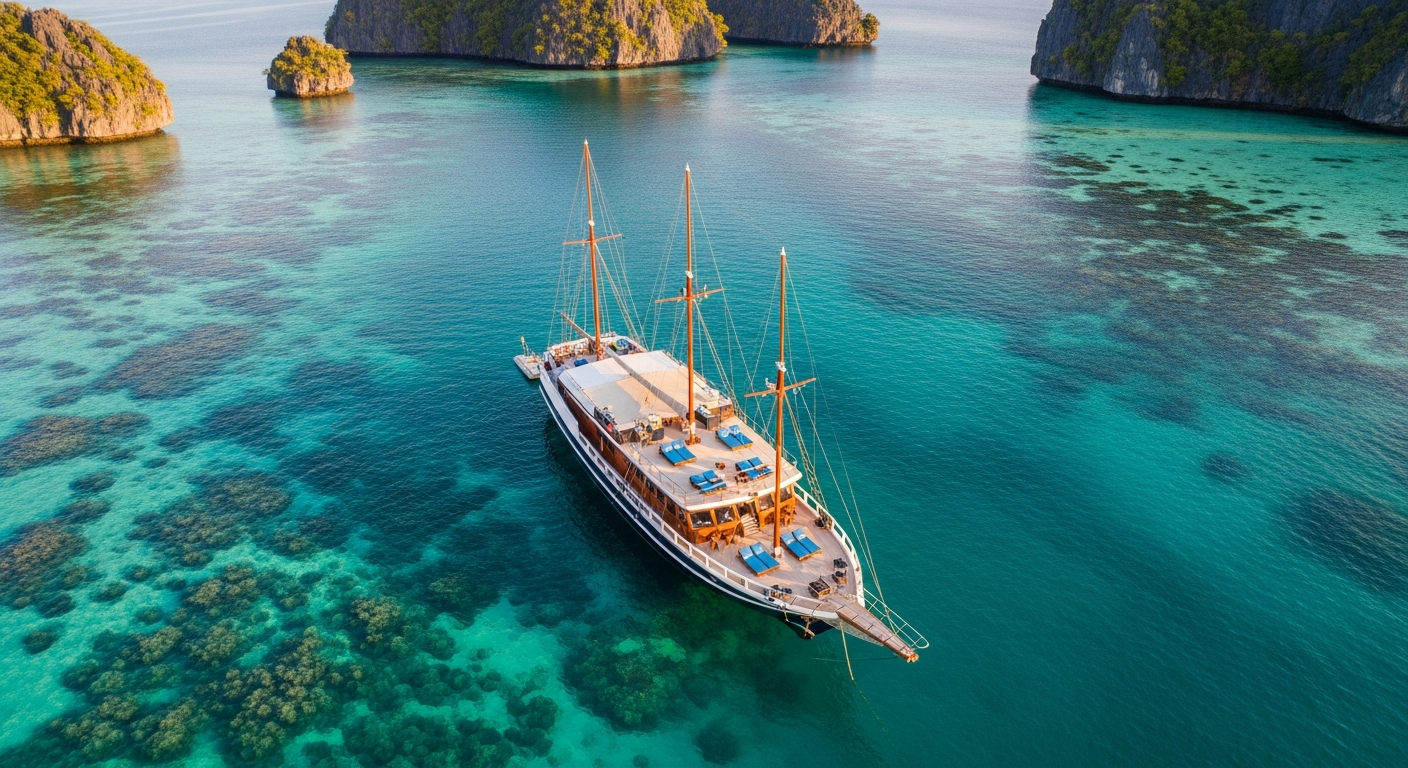
You do not choose activities. You choose a mood. Today: dive until your body says stop, at a site the captain has kept secret for fifteen years. Tomorrow: perhaps nothing at all—a book on deck, a swim off the stern, lunch that stretches into the afternoon as the phinisi drifts in a lagoon so quiet you can hear fish breaking the surface 50 meters away. The day after: kayak into a cave system that does not appear on any tourist map, because the captain learned of it from a fisherman he has known since childhood.
This is the invisible itinerary—a concept that represents the sharpest edge of luxury travel in 2026. The world's wealthiest travelers have moved beyond collecting destinations. The new currency is depth, presence, and the radical luxury of having absolutely nothing scheduled. Luxury travel advisors globally report that their highest-spending clients now explicitly request slower itineraries, fewer stops, and longer stays in single destinations. Raja Ampat, with 1,500 islands, zero tourist crowds, and an environment that rewards patient exploration over rushing, is the ideal destination for this philosophy.
Why the Invisible Itinerary Is the Future of Luxury Travel
The conventional luxury cruise operates on anxiety: get up early, hit the dive site before other boats arrive, rush to the next landmark, photograph the viewpoint, check the box, move on. Guests return home with hundreds of photos and the vague sense that they saw everything but experienced nothing. The invisible itinerary inverts this model entirely.
On a slow cruise, the captain briefs you each evening—not with a fixed plan for tomorrow, but with options shaped by weather, marine life intelligence from local contacts, and his reading of your group's energy. Wind favorable for Wayag? Perhaps we sail north. Manta aggregation reported at a cleaning station in Dampier Strait? We could investigate. Or perhaps today you simply want to anchor in a protected bay, snorkel the house reef at your own pace, and have lunch served whenever you feel like eating. The answer to all of these is yes.
What a Week of Invisible Itinerary Actually Looks Like
No two slow cruises are identical—that is the point. But the rhythm develops organically and typically follows a pattern that guests describe as the most natural schedule they have experienced since childhood summer holidays.
Morning
You wake when your body wakes. Coffee is available from 6 AM on the upper deck, and the crew never comments on your timing. Some mornings you are in the water by 7 AM for a dawn snorkel when the reef is most active. Other mornings you read until 10 AM and skip breakfast entirely in favor of an early lunch. The phinisi's chef adapts meal timing to your rhythm, not the reverse.
Midday
The vessel may reposition during late morning—a gentle cruise of an hour or two to a new anchorage. Or it may not move at all. The captain identifies these decisions based on factors invisible to you: current patterns, wind shifts, intelligence from local fishermen about marine life movements. You experience the result—a perfect anchorage, a pristine reef—without the operational machinery being visible. Hence: invisible itinerary.
Afternoon
The options are limitless because they are unscheduled. Kayak into a karst channel. Dive a site the captain has been wanting to show someone for years. Visit a remote village where the chief remembers the captain by name. Take the tender to a private beach and simply sit in the shallows watching reef fish. Or stay on the boat—the upper deck hammock, a cold drink, and the view of karst islands against equatorial sky is an activity in itself.
Evening
The chef uses whatever was fresh that day—sometimes local fishermen paddle to the phinisi offering the morning's catch, and dinner becomes a spontaneous feast of grilled parrotfish, crayfish, and reef squid that was swimming three hours ago. After dinner, the absence of light pollution reveals the Milky Way in detail that most people have never witnessed. The guide points out constellations. Or you simply sit in silence and let the sky speak for itself.
The Captain's Secret Library
Every captain who sails Raja Ampat for a decade or more accumulates a personal library of locations that do not appear in guidebooks, on dive maps, or in other operators' itineraries. A reef passage where schooling barracuda form a tornado at a specific current phase. A bay where bioluminescent plankton lights up the water on moonless nights. A beach where coconut crabs the size of footballs emerge at dusk. A cave with ancient rock paintings that few non-locals have ever seen.
On a conventional charter, the captain shares none of this—the schedule does not permit detours. On a slow cruise, the captain's secret library becomes your itinerary. These are the moments that cannot be purchased at any price on a fixed-schedule trip. They emerge only when time pressure is removed and the captain trusts that you will appreciate what he is sharing.
Ask your captain about his personal favorite spot in Raja Ampat—the place he goes when he is not working. On a slow cruise, he will take you there. On a fixed itinerary, he never has time. This single access point often produces the trip's most memorable moment.
Ideal Duration for Slow Cruising
| Duration | Experience Level | Best For |
|---|---|---|
| 7 nights | Introduction to slow cruising | Couples, first-time Raja Ampat visitors who want flexibility |
| 10 nights | Deep immersion | Families, small groups, divers who want unhurried multi-region coverage |
| 14 nights | Full transformation | UHNWI travelers, sabbatical seekers, those who want to genuinely disconnect |
Our recommendation for first-time slow cruisers: 10 nights minimum. Seven nights works, but day one and day seven involve boarding and disembarking logistics, meaning your true slow-cruise window is five days. At 10 nights, you have eight full days of invisible itinerary—enough for the rhythm to settle, for your internal clock to recalibrate, and for the experience to move from vacation into something closer to temporary life change.
Pricing for Slow Cruise Charters
| Vessel | 7 Nights | 10 Nights | 14 Nights |
|---|---|---|---|
| Premium Phinisi (8–10 guests) | $31,500 | $45,000 | $63,000 |
| Luxury Phinisi (10–12 guests) | $42,000 | $60,000 | $84,000 |
| Super-Phinisi (12–14 guests) | $66,500 | $95,000 | $133,000 |
Quick Answers
Frequently Asked Questions
No fixed schedule. Your captain adapts daily based on weather, mood, and marine life conditions. You choose the experience, the crew creates the day.
Guests report higher satisfaction than on packed itineraries. Without pressure to tick boxes, you discover hidden spots and experience genuine presence.
Minimum 7 nights, ideal 10–14. The concept works best when time pressure is eliminated entirely.
Absolutely. A slow cruise includes all major highlights—you simply experience them at your own pace without rushing between checkpoints.
Experience the Invisible Itinerary
Discover What Happens When You Stop Scheduling and Start Living
Raja Ampat slow cruise—the ultimate modern luxury.
Design Your Slow CruiseExplore More
Explore More Luxury Raja Ampat Experiences
Continue exploring: yacht charter · luxury cruise · diving experiences · destinations
Ready to plan? book your voyage